
Overgiving: The Comfort of Being Needed

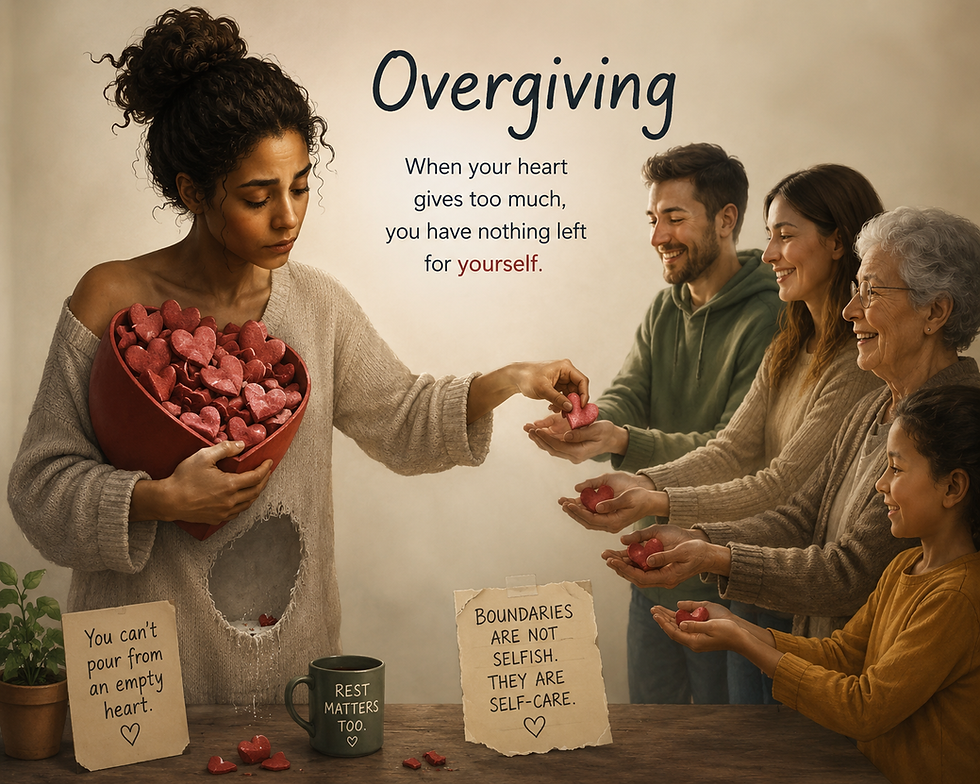
In continuing with my conversations with Abba about healthy relationships, I felt like writing about this aspect of relationship posture. This territory is extremely deep, because for many people, being needed has become intertwined with identity, safety, belonging, value, and even spirituality. Some people do not simply enjoy helping others; they derive their sense of worth from being needed. And those are not the same thing.
Helping can be healthy. Needing to be needed can quietly become bondage. Now this blog isn't about shaming anyone, but it is about self-awareness.
What “Comfortable Being Needed” Can Look Like
Always being the rescuer.
Constantly positioning oneself as a helper, advisor, fixer, or caretaker.
Feeling uncomfortable when those who depended on you become independent.
Feeling emotionally displaced when others no longer rely on you.
Feeling anxious when not included in someone’s crisis or process.
Overextending to remain important in relationships.
Again, I am not trying to shame you. I am trying to help you recognize patterns.
Why does one live as an overgiver?
Sometimes we overgive because giving makes us feel valuable. If people need us, then we feel important. If people depend on us, then we feel secure in the relationship.
But then the question becomes, Who am I when nobody needs anything from me? I think that is a profound spiritual and emotional question.
In working as a therapist and coach, I was trained using the Iceberg model; we do not address what we see on the surface; instead, we look for what's beneath. So, what could be beneath this pattern of overgiving? FEAR.
fear of abandonment
fear of irrelevance
fear of invisibility
fear of not mattering
fear that if we stop giving, people will stop choosing us
Many people do not consciously choose overgiving as a relational style. They adapt to it. Somewhere early in life, they may have learned an emotional equation:
I am loved when I perform.
I matter when I help.
I am safest when I take care of everyone else.
I earn belonging by anticipating needs.
If I become difficult, needy, emotional, or inconvenient, connection may be withdrawn.
What begins as adaptation eventually becomes identity. Over time, this can settle into what we might call a lifelong relational posture- not simply something a person does, but the way they move through relationships, the way they interpret love, safety, worth, and connection.
This relational posture becomes natural. Automatic. Unquestioned. And so you may hear this person say, “This is just who I am.”
When we adapt to this relational posture, this is how it tends to be rewarded in adulthood.
The over-functioning child becomes the responsible adult. The emotionally attentive child becomes the dependable friend. The peacekeeping child becomes the accommodating partner. The child who learned to scan the room for emotional danger becomes highly intuitive and emotionally perceptive. Many of these traits look admirable from the outside. In fact, they are often praised for maturity, selflessness, loyalty, spirituality, or strength.
But underneath can live a quiet fear:
If I stop giving, will I still be loved?
If I have needs too, will I become a burden?
If I disappoint people, will they leave?
If I rest, who will hold everything together?
This is why over-giving can become a lifelong relational posture because it becomes tied to survival, attachment, and identity.
The relational posture of overgiving can also impact the nervous system. The person’s nervous system may begin to associate safety with usefulness. They feel most secure when they are needed, most valuable when they are helping, and most emotionally protected when they stay attentive to everyone else’s emotions while neglecting their own.
Over time, they may lose connection with themselves because their attention has been trained outward for so long. So, they may begin to struggle to answer simple inward questions:
What do I need?
What do I feel?
What do I want apart from being needed?
Who am I when I am not serving, fixing, helping, or carrying?
The tragedy is that the overgiver may spend years being deeply appreciated while rarely feeling deeply known. But eventually, that posture becomes heavy. Because relationships built upon performance often produce exhaustion instead of intimacy.
The Spiritual Layer
I want to touch on the spiritual layer because we can become more comfortable being used by God than being loved by God. This is where activity can become identity. Service can become worth. Ministry can become validation. Being needed can distract us from the deeper work of asking:
“Do I believe God loves me apart from what I provide, apart from my service?”
And this is where transformation begins: when a person slowly learns that love does not have to be earned through usefulness. Sometimes people feel more secure being useful to God than being loved by God. Why is this??
Being used feels measurable. Clear. Productive.
“I prayed.”
“I served.”
“I showed up.”
“I sacrificed.”
“I helped.”
“I led.”
“I poured out.”
Activity can give one a sense of identity because activity produces evidence. It allows a person to point to something tangible and say: “See? I matter.”
But being loved by God apart from performance requires a different kind of surrender. It requires sitting still long enough to confront the frightening question: Who am I when I am not producing spiritual results?
For many people, especially those who learned early in life that love was connected to performance, usefulness becomes emotionally safer than intimacy. A person can spend years doing things for God while quietly struggling to receive from God. That tension can be painful. The soul can become addicted to being needed, and not necessarily out of pride. Even spirituality can unconsciously become another place where worth is earned instead of received. As a result, ministry becomes validation. Service becomes identity. Sacrifice becomes proof of value. And eventually, the person may begin to fear rest, fear silence, fear obscurity, or fear no longer being needed. Because if usefulness is removed, they are forced to confront the deeper question: Am I lovable apart from what I provide?
This is why transformation is so sacred and so difficult. God invites us out of a performance-based relationship into belovedness.
Not just servant....Beloved.
Not just a vessel....Child.
Not just a worker....Friend.
And many people can intellectually quote, “God loves me.”
But emotionally, they still feel they must maintain that love through constant usefulness.
This is why some people become uncomfortable when they are not doing. Dear beloved, God never intended service to replace intimacy. The deepest transformation begins when a person realizes:“I do not have to exhaust myself to deserve love.”
The greatest miracle for some people is not being used powerfully by God.
It is believing they are loved deeply by God even when they are quiet, hidden, resting, uncertain, or empty-handed. So, maybe the invitation is this:
To stop confusing being useful with being beloved.
To recognize that God never asked us to build our identity upon exhaustion, performance, or endless proving.
He did not create us merely to function for Him, but to fellowship with Him.
If we are not careful, we can spend so much time pouring out that we never learn how to simply remain. Because activity may impress people, but belovedness heals the soul.
And perhaps the deepest healing is not found in doing more for God, but in finally believing we are loved by God. Loved in our humanity. Loved when our hands are empty. Loved when we have nothing left to prove. Maybe transformation begins the moment we stop asking, “How useful am I?” and start asking, “Can I receive love without earning it?”
I hope this tete-a-tete has been helpful to you and I would appreciate it if you would share it with someone else who may benefit.
Beginning in June, blogs will be sent only to those who have subscribed to receive them.
As I continue growing in this space with intention and care, I'm learning to be a good steward of the resources connected to my website and email outreach. My platform counts messages sent in monthly email campaign limits, even when emails go unopened or bounce back.
I also want to honor your inbox by sending these writings only to those folk who wish to receive them.
If these reflections and spiritual insights have encouraged you along the way and you would love to continue this journey with me, I would be honored for you to subscribe.
Thank you so much for meeting me here at Conversations with My Dad since May 2019! I look forward to continuing to share my conversations with you!
God bless,
WandaP


Comments